Insights / Sleep × Skin–Hair Beauty
When Rest
Becomes Renewal
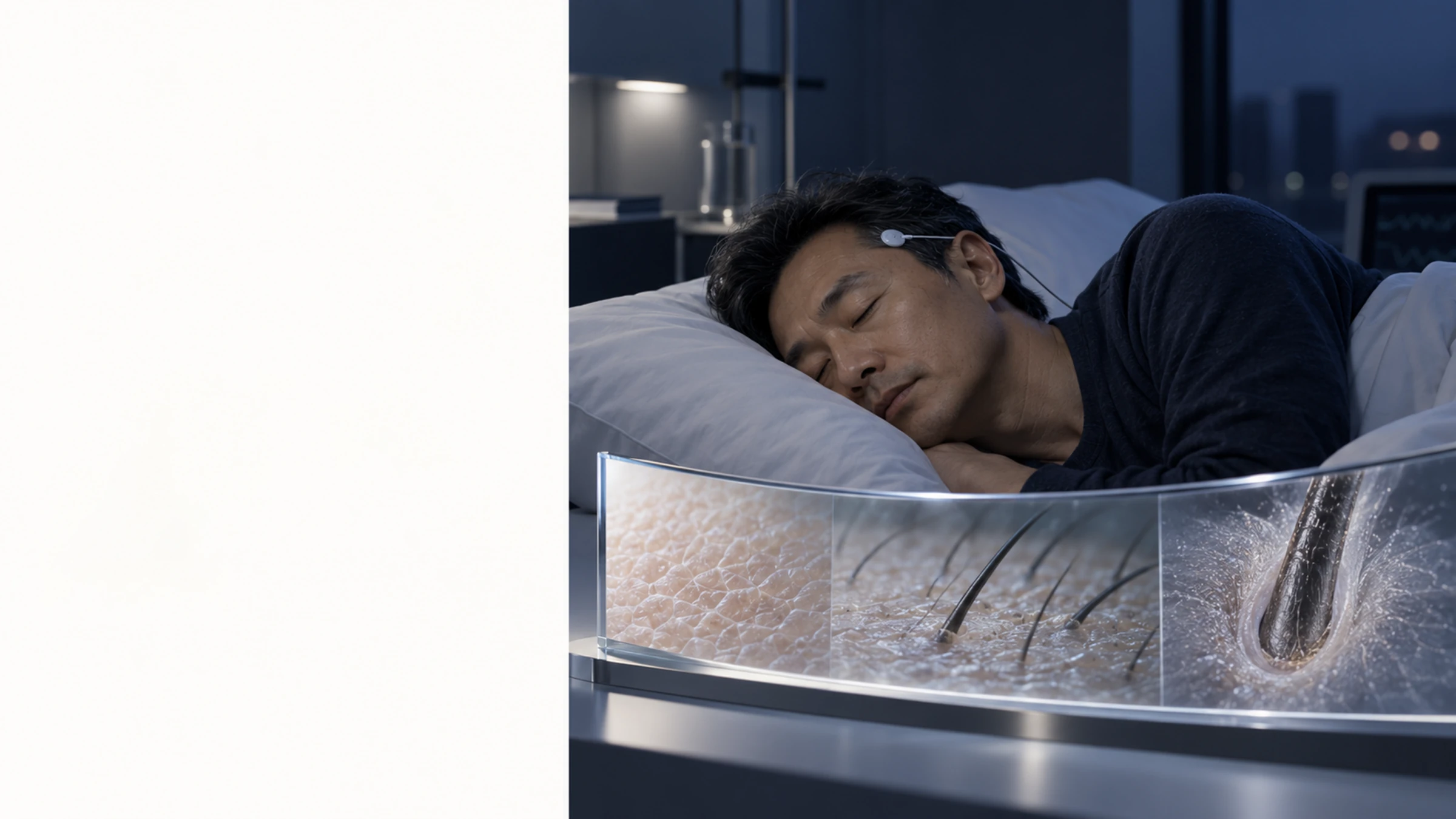
A&S investigates how restorative sleep shapes the biological conditions for skin renewal, scalp balance and hair resilience.
Explore the science
How Sleep Shapes the
Skin–Hair Beauty Axis
01
02
03
04
Sleep Quality
Sleep-Dependent Signals
Neurochemical & Neuroendocrine
Regulation
Sensory–Affective Context
INTEGRATED RECOVERY ENVIRONMENT
Skin
Scalp
Hair
Read text and explanation
Integrated system overview
How Sleep Shapes the Skin–Hair Beauty Axis
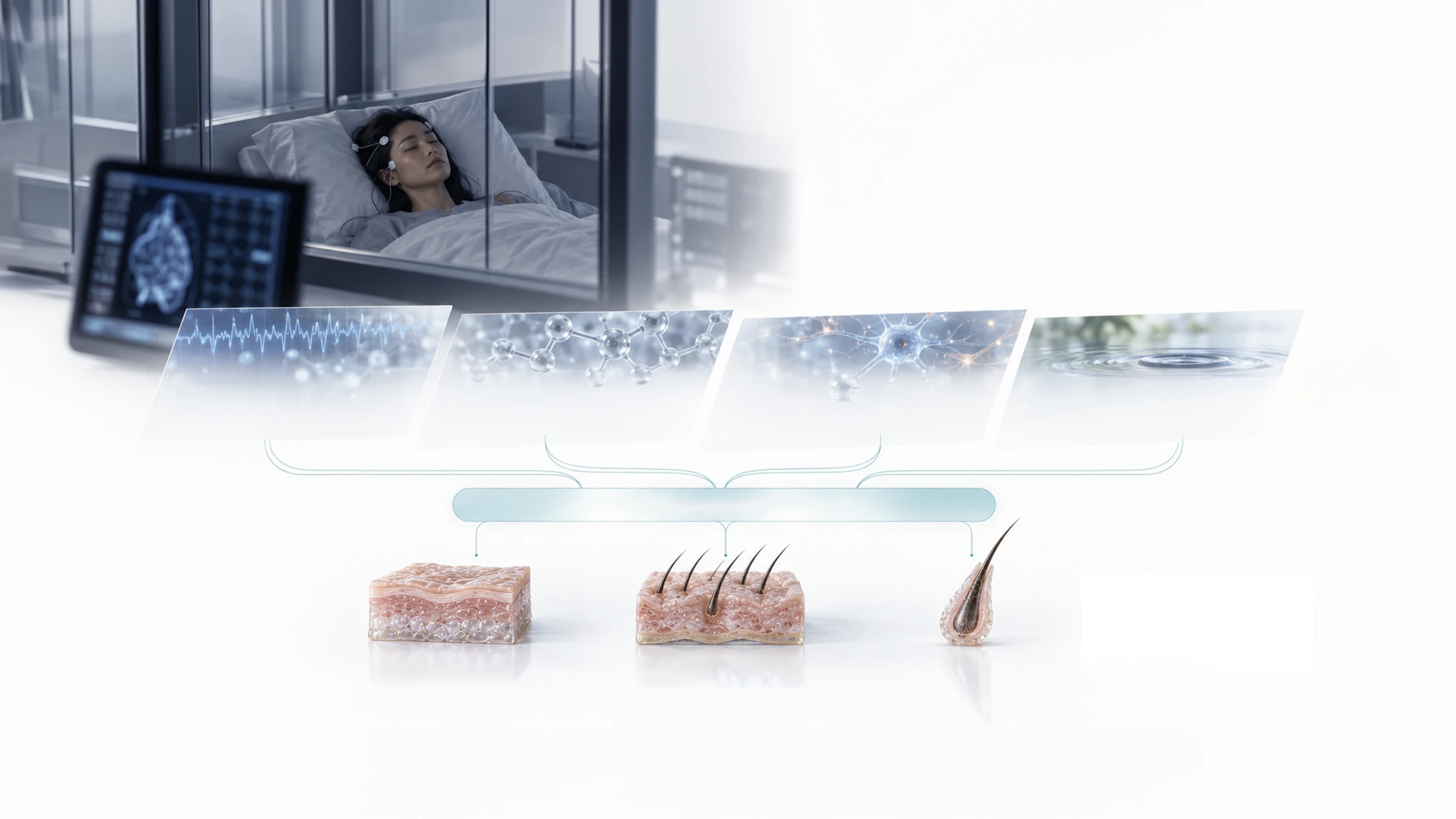
Sleep influences skin, scalp and hair through an integrated recovery environment. Four interacting domains shape the biological conditions that support repair, balance and resilience.
-
01
Sleep Quality
Duration · Continuity · NREM–REM balance · Circadian alignment
-
02
Sleep-Dependent Signals
Melatonin and cortisol rhythms · Autonomic balance · Immune and metabolic regulation
-
03
Neurochemical & Neuroendocrine Regulation
Neurotransmitter balance · Stress-axis regulation · Neurotrophic and endocrine support
-
04
Sensory–Affective Context
Sensory environment · Affective state · Stress buffering · Autonomic modulation
Integrated recovery environment
Integrated system overview
How Sleep Shapes the Skin–Hair Beauty Axis
-
Sleep Quality
Duration · Continuity · NREM–REM balance · Circadian alignment
-
Sleep-Dependent Signals
Melatonin and cortisol rhythms · Autonomic balance · Immune and metabolic regulation
-
Neurochemical & Neuroendocrine Regulation
Neurotransmitter balance · Stress-axis regulation · Neurotrophic and endocrine support
-
Sensory–Affective Context
Sensory environment · Affective state · Stress buffering · Autonomic modulation
Integrated recovery environment
Sleep influences skin, scalp and hair through an integrated recovery environment. Four interacting domains shape the biological conditions that support repair, balance and resilience.

The Skin’s Nighttime
Renewal System
01
Barrier Homeostasis
REBUILDING THE SURFACE
02
Cellular Renewal
RESTORING CELLULAR ORDER
Read text and explanation
Skin biology
The Skin’s Nighttime Renewal System
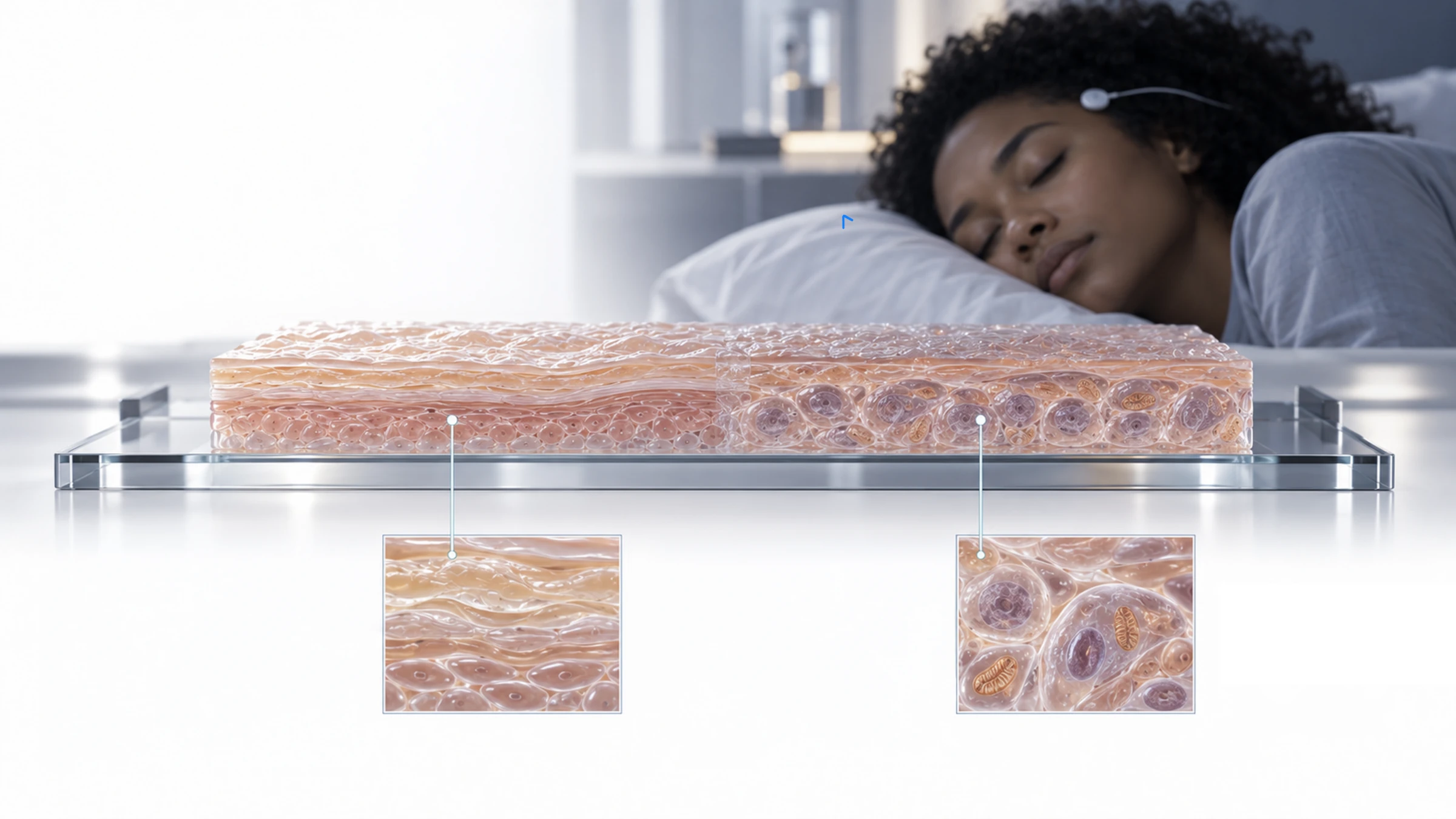
During restorative sleep, circadian timing and recovery signaling create a biological window for epidermal maintenance. At the surface, barrier cohesion and cellular renewal work together to restore functional resilience.
-
01
Barrier Homeostasis
Rebuilding the surface
Epidermal lipids and tight junctions help reinforce barrier cohesion, limit transepidermal water loss and improve moisture retention.
- Lipid organization
- Tight-junction support
- TEWL control
-
02
Cellular Renewal
Restoring cellular order
Keratinocyte turnover, DNA-repair activity and mitochondrial maintenance support orderly epidermal repair and renewal.
- Keratinocyte turnover
- DNA repair
- Mitochondrial maintenance
Skin biology
The Skin’s Nighttime Renewal System
During restorative sleep, circadian timing and recovery signaling create a biological window for epidermal maintenance. At the surface, barrier cohesion and cellular renewal work together to restore functional resilience.
-
Cellular Renewal
Restoring cellular order
Keratinocyte turnover, DNA-repair activity and mitochondrial maintenance support orderly epidermal repair and renewal.
- Keratinocyte turnover
- DNA repair
- Mitochondrial maintenance

Beyond the Surface:
Resilience from Within
03
Dermal Matrix Support
MAINTAINING STRUCTURAL INTEGRITY
04
Inflammation Control
RESTORING A CALMER MICROENVIRONMENT
05
Pigment & Tone Regulation
SUPPORTING EVENNESS AND CLARITY
Read text and explanation
Skin biology
Beyond the Surface: Resilience from Within
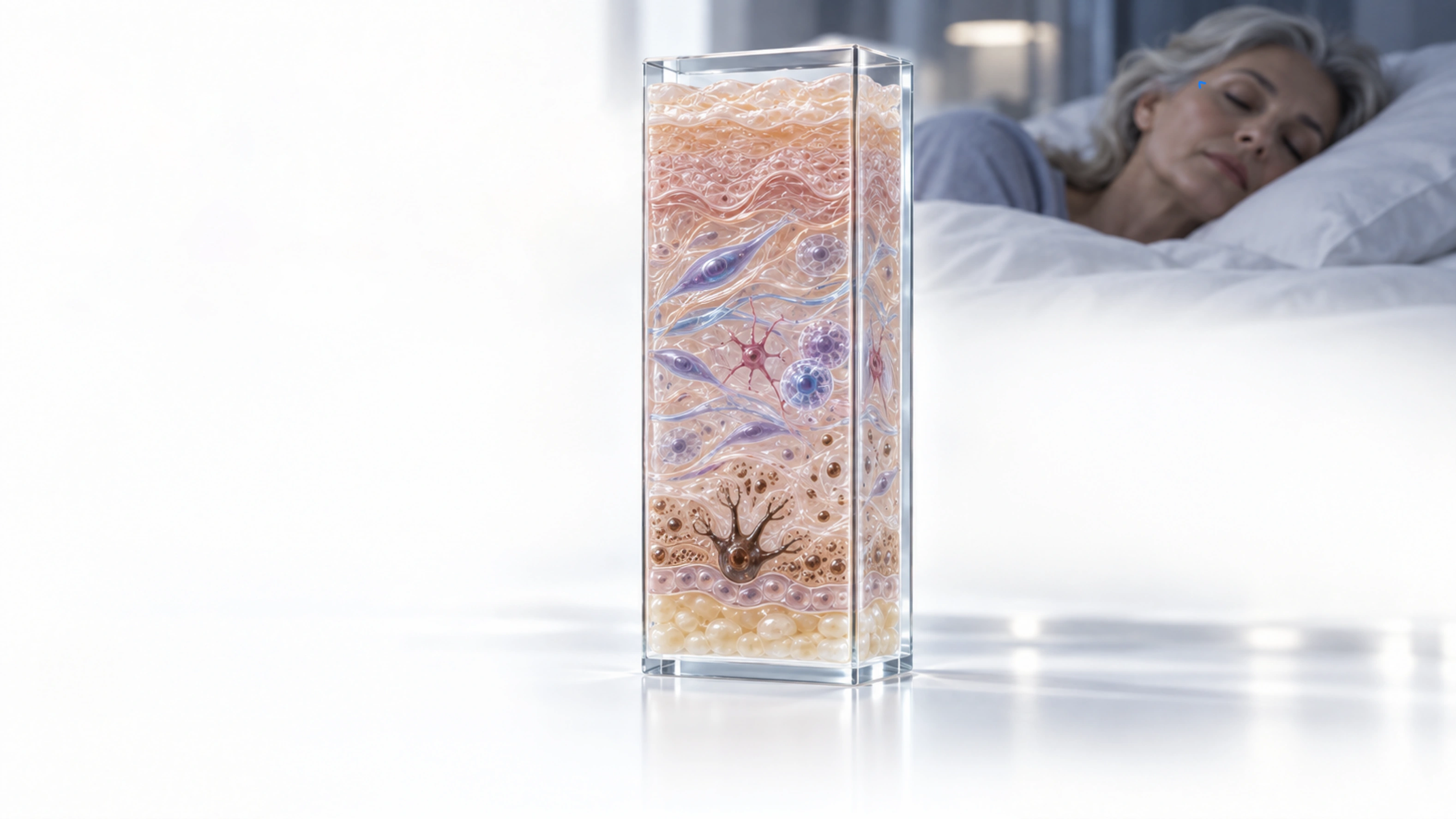
Nighttime renewal extends beyond the epidermis. Within the dermis and its surrounding microenvironment, structural maintenance, inflammatory regulation and pigment stability help preserve balanced skin function over time.
-
03
Dermal Matrix Support
Maintaining structural integrity
Fibroblast activity supports collagen and elastin maintenance, while balanced extracellular-matrix remodeling helps preserve firmness, elasticity and repair capacity.
Collagen synthesis · Elastin maintenance · ECM remodeling
-
04
Inflammation Control
Restoring a calmer microenvironment
Regulation of cytokine activity, mast-cell reactivity and low-grade inflammation supports recovery and reduces persistent biological stress within the skin.
Cytokine balance · Mast-cell stability · Low-grade inflammation
-
05
Pigment & Tone Regulation
Supporting evenness and clarity
Oxidative stability and balanced melanocyte activity help maintain more even pigment distribution, tone and visible radiance.
Melanocyte balance · Oxidative stability · Tone uniformity
Skin biology
Beyond the Surface: Resilience from Within
-
Dermal Matrix Support
Maintaining structural integrity
Fibroblast activity supports collagen and elastin maintenance, while balanced extracellular-matrix remodeling helps preserve firmness, elasticity and repair capacity.
Collagen synthesis · Elastin maintenance · ECM remodeling
-
Inflammation Control
Restoring a calmer microenvironment
Regulation of cytokine activity, mast-cell reactivity and low-grade inflammation supports recovery and reduces persistent biological stress within the skin.
Cytokine balance · Mast-cell stability · Low-grade inflammation
-
Pigment & Tone Regulation
Supporting evenness and clarity
Oxidative stability and balanced melanocyte activity help maintain more even pigment distribution, tone and visible radiance.
Melanocyte balance · Oxidative stability · Tone uniformity
Nighttime renewal extends beyond the epidermis. Within the dermis and its surrounding microenvironment, structural maintenance, inflammatory regulation and pigment stability help preserve balanced skin function over time.

The Scalp as a
Living Ecosystem
01
Barrier & Sebum Balance
PROTECTING THE FOLLICULAR SURFACE
02
Microcirculation
SUSTAINING LOCAL SUPPLY
03
Immune, Microbiome &
Oxidative Balance
MAINTAINING A STABLE ENVIRONMENT
Read text and explanation
Scalp microenvironment
The Scalp as a Living Ecosystem
Sleep-dependent recovery helps maintain the local conditions that surround each follicle. Barrier function, vascular supply and biological balance work together to support a stable scalp microenvironment.
-
01
Barrier & Sebum Balance
Protecting the follicular surface
Balanced lipid organization and sebum distribution help preserve barrier integrity, moisture control and a stable environment around follicular openings.
Barrier cohesion · Sebum homeostasis · Moisture balance
-
02
Microcirculation
Sustaining local supply
Healthy microvascular function supports oxygen and nutrient delivery to metabolically active tissues surrounding the follicle.
Oxygen delivery · Nutrient supply · Microvascular support
-
03
Immune, Microbiome & Oxidative Balance
Maintaining a stable environment
Regulated immune activity, microbial balance and antioxidant protection help limit inflammatory and oxidative stress within the scalp.
Immune homeostasis · Microbiome ecology · Oxidative protection
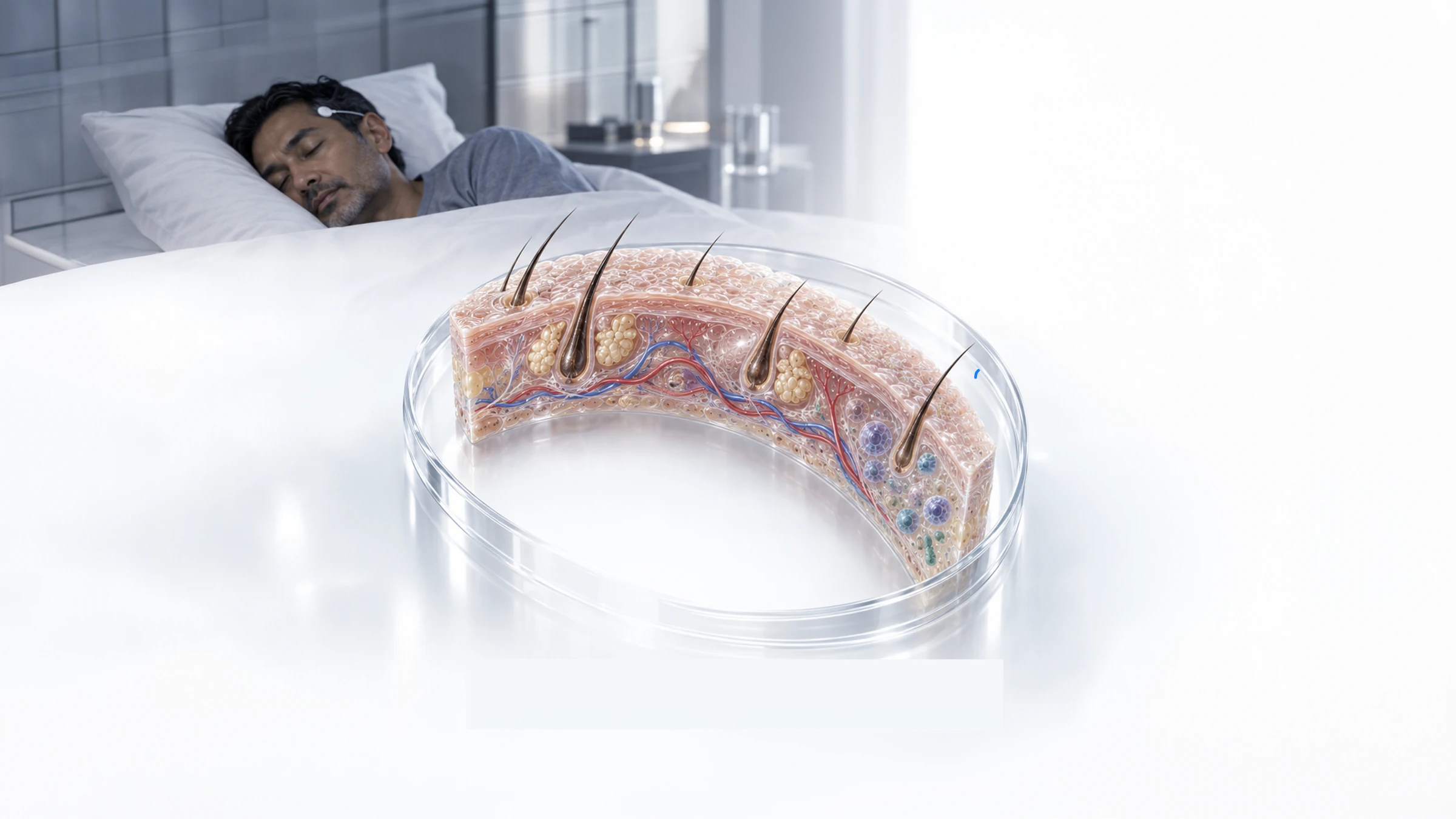
Scalp microenvironment
The Scalp as a Living Ecosystem
Sleep-dependent recovery helps maintain the local conditions that surround each follicle. Barrier function, vascular supply and biological balance work together to support a stable scalp microenvironment.
-
Microcirculation
Sustaining local supply
Healthy microvascular function supports oxygen and nutrient delivery to metabolically active tissues surrounding the follicle.
Oxygen delivery · Nutrient supply · Microvascular support
-
Immune, Microbiome & Oxidative Balance
Maintaining a stable environment
Regulated immune activity, microbial balance and antioxidant protection help limit inflammatory and oxidative stress within the scalp.
Immune homeostasis · Microbiome ecology · Oxidative protection

How Healthy Hair
Is Formed
THE HAIR CYCLE
ANAGEN
CATAGEN
TELOGEN
01
Follicle Cycling
REGULATING GROWTH AND TRANSITION
02
Matrix-Cell Activity
GENERATING THE HAIR SHAFT
03
Fiber Formation & Protection
MAINTAINING STRUCTURAL QUALITY
Read text and explanation
Hair follicle biology
How Healthy Hair Is Formed
During restorative sleep, recovery-related biological conditions support the cellular activity, cycle regulation and structural processes required for normal follicular function and hair-fiber formation.
The Hair Cycle
- Anagen
- Catagen
- Telogen
-
01
Follicle Cycling
Regulating growth and transition
Coordinated follicular signaling supports the active anagen phase and orderly transition through catagen and telogen.
Anagen activity · Cycle coordination · Follicular resilience
-
02
Matrix-Cell Activity
Generating the hair shaft
Rapidly dividing matrix cells differentiate and keratinize to produce the organized structures of the emerging hair fiber.
Cell proliferation · Differentiation · Keratinization
-
03
Fiber Formation & Protection
Maintaining structural quality
Keratin organization and antioxidant defense help protect developing follicular cells and preserve the integrity of the formed hair fiber.
Keratin organization · Oxidative protection · Fiber stability
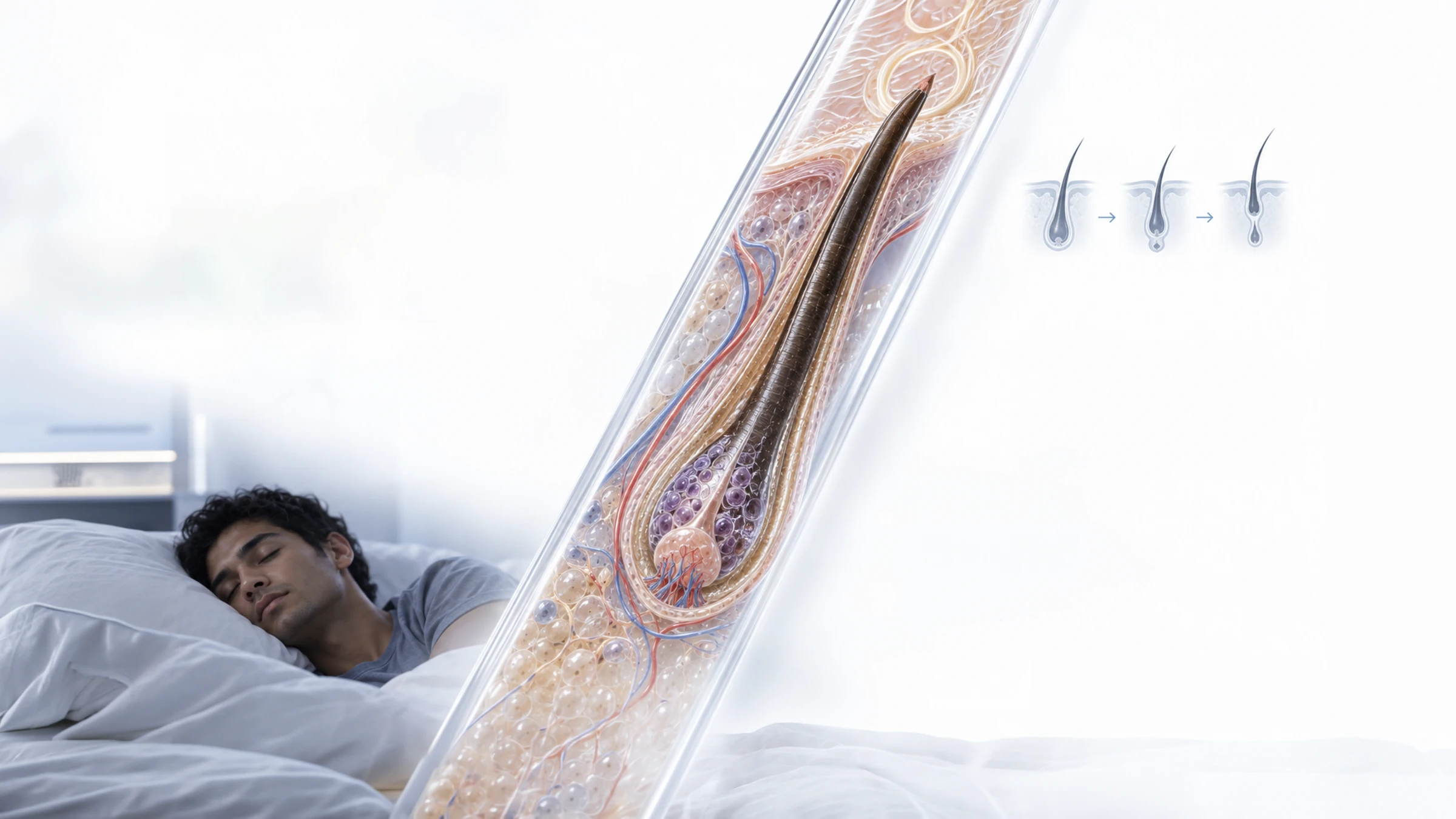
Hair follicle biology
How Healthy Hair Is Formed
During restorative sleep, recovery-related biological conditions support the cellular activity, cycle regulation and structural processes required for normal follicular function and hair-fiber formation.
The Hair Cycle
- Anagen
- Catagen
- Telogen
-
Follicle Cycling
Regulating growth and transition
Coordinated follicular signaling supports the active anagen phase and orderly transition through catagen and telogen.
Anagen activity · Cycle coordination · Follicular resilience
-
Matrix-Cell Activity
Generating the hair shaft
Rapidly dividing matrix cells differentiate and keratinize to produce the organized structures of the emerging hair fiber.
Cell proliferation · Differentiation · Keratinization
-
Fiber Formation & Protection
Maintaining structural quality
Keratin organization and antioxidant defense help protect developing follicular cells and preserve the integrity of the formed hair fiber.
Keratin organization · Oxidative protection · Fiber stability

The Visible Expression
of Nighttime Recovery
Skin
HYDRATED · SMOOTH · RESILIENT
Scalp
CALM · BALANCED · SUPPORTED
Hair
STABLE · STRONG · HEALTHY-LOOKING
SHARED OUTCOMES
Read text and explanation
Shared beauty outcomes
The Visible Expression of Nighttime Recovery
Across skin, scalp and hair, restorative sleep supports the biological conditions associated with repair, balance and resilience. These interconnected effects shape how healthy beauty is expressed over time.
Skin
Hydrated · Smooth · Resilient
Stronger barrier function, improved moisture retention, greater softness and elasticity, more even tone and a healthier-looking complexion.
Scalp
Calm · Balanced · Supported
A more stable barrier, balanced sebum and microbial ecology, and a less reactive environment surrounding the follicles.
Hair
Stable · Strong · Healthy-looking
Balanced follicular cycling, resilient fiber formation and improved structural quality of the emerging hair shaft.
Shared Outcomes
- Repair readiness
- Barrier resilience
- Balanced microenvironment
- Radiance & clarity
- Healthy-aging appearance
- Hair-cycle stability
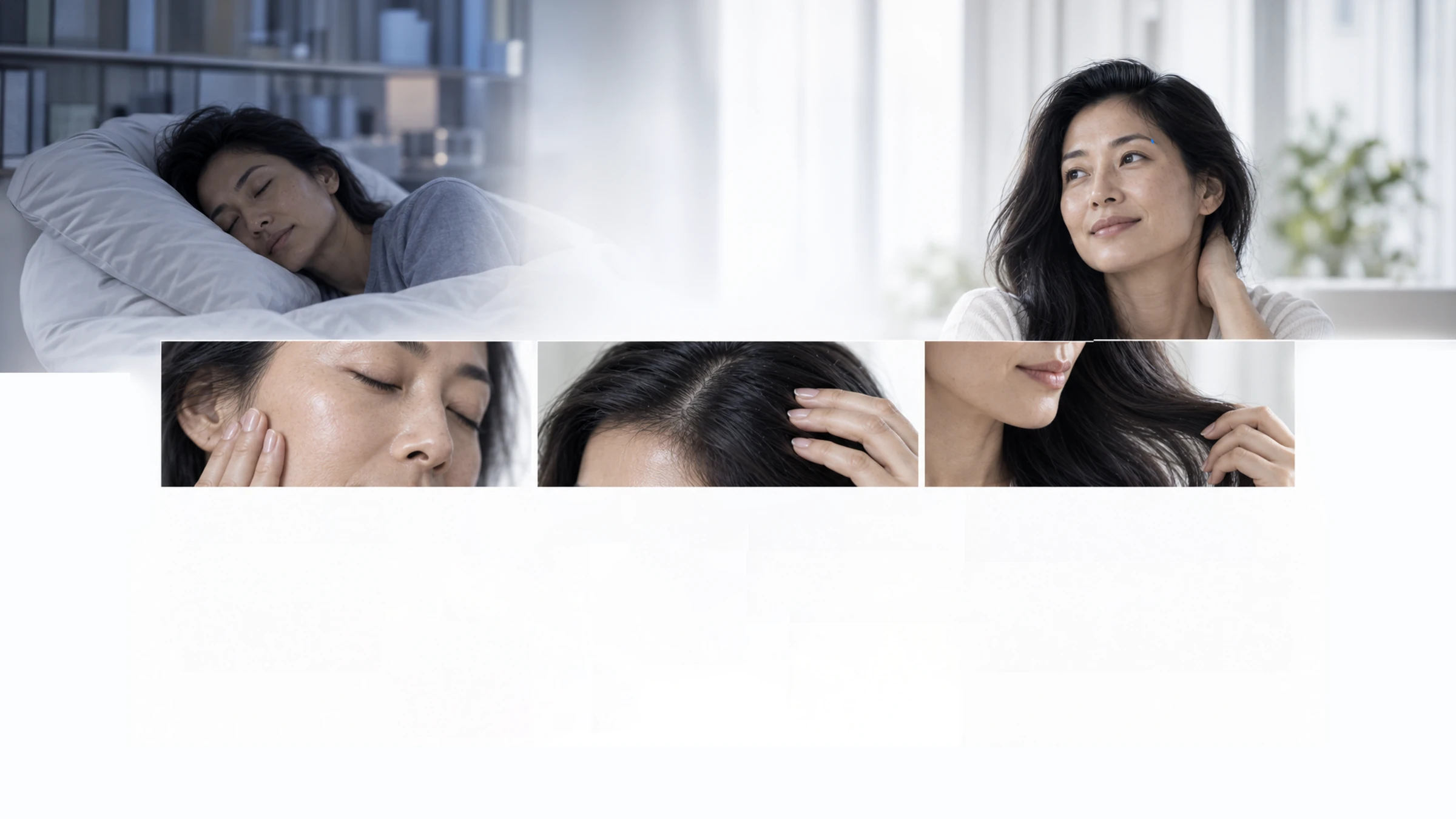
Shared beauty outcomes
The Visible Expression of Nighttime Recovery
Across skin, scalp and hair, restorative sleep supports the biological conditions associated with repair, balance and resilience. These interconnected effects shape how healthy beauty is expressed over time.
Skin
Hydrated · Smooth · Resilient
Stronger barrier function, improved moisture retention, greater softness and elasticity, more even tone and a healthier-looking complexion.
Scalp
Calm · Balanced · Supported
A more stable barrier, balanced sebum and microbial ecology, and a less reactive environment surrounding the follicles.
Hair
Stable · Strong · Healthy-looking
Balanced follicular cycling, resilient fiber formation and improved structural quality of the emerging hair shaft.
Shared Outcomes
- Repair readiness
- Barrier resilience
- Balanced microenvironment
- Radiance & clarity
- Healthy-aging appearance
- Hair-cycle stability